What is global macro?
Why this matters
Section titled “Why this matters”On the morning of 16 September 1992, the British government did something extraordinary. To stop traders selling the pound, it raised interest rates from 10% to 12%, and later that same day promised to raise them again to 15% (source). It didn’t work. By evening, the UK had given up and pulled the pound out of the European Exchange Rate Mechanism, the system that had been holding its value in a fixed band against other European currencies (source).
On the other side of that trade sat George Soros’s Quantum Fund, which had bet billions that the pound would fall. The fund made roughly $1 billion (source). It didn’t win because it knew something secret about a company. It won because it had a better read on a whole economy than the government running it.
That is global macro: investing based on how economies, governments and central banks behave, and how those forces ripple through every market in the world. This book teaches you to think that way from scratch.
What “macro” means
Section titled “What “macro” means”Economics comes in two sizes.
Microeconomics is about individual players: a single shop setting its prices, a single family deciding what to buy, a single company deciding whether to hire.
Macroeconomics is about the whole economy at once: how fast a country is growing, how quickly prices are rising, how many people have jobs, and what the government and central bank are doing about it.
Most investing you hear about is micro. A stock picker asks, “Is this company good? Will its profits grow?” A macro investor asks a different question: “What are interest rates, inflation and currencies going to do, and what will that do to everything?”
That second question matters more than it sounds. When interest rates jump, it doesn’t just hurt one company. It changes what every house, every bond and every stock is worth at the same time. In 2022, when the US Federal Reserve raised rates faster than it had in decades (source), stocks and bonds fell together, which almost never happens. Good companies went down with bad ones. Only a macro lens explains why.
What global macro investors trade
Section titled “What global macro investors trade”A global macro investor can trade almost anything, anywhere, as long as it expresses a view on the big picture. In practice, that means four main markets:
- Interest rates and bonds. Bets on whether a central bank will raise or cut rates, and on what that does to government bond prices.
- Currencies. Bets that one currency will rise or fall against another, such as the pound against the German mark in 1992.
- Commodities. Oil, gold, copper and wheat, which respond to growth, inflation, wars and weather.
- Stock indices. Not individual companies, but whole markets: “US stocks”, “Japanese stocks”, “emerging-market stocks”.
Two ideas show up again and again in how macro investors trade.
The first is leverage: using borrowed money (or financial contracts that behave like borrowed money) to take a bigger position than your own cash would allow. Leverage lets a fund turn a 2% move in a currency into a much bigger gain. It also turns a 2% move the wrong way into a much bigger loss. We’ll see in the timeline below how that destroyed one of the most famous funds ever.
The second is the asymmetric bet: a trade where the potential gain is much larger than the potential loss. In 1992, the pound was held inside a band by a currency peg. If the peg held, the pound would barely move and Soros would lose a little. If it broke, the pound would fall a long way. Small downside, big upside. Macro investors spend much of their time hunting for exactly that shape of trade.
How a macro investor thinks
Section titled “How a macro investor thinks”Every good macro trade, however complicated, rests on four questions. You’ll use this framework throughout the book, and we’ll build it out fully in Part V.
- Thesis. What do I believe about the world that the market doesn’t? “The UK can’t keep interest rates this high with its economy this weak.”
- Catalyst. What will force the market to realise it? “The pressure will peak when speculators test the Bank of England’s reserves.”
- Trade. Which market expresses the view most cleanly? “Sell pounds, buy German marks.”
- Risk. How much could I lose if I’m wrong, and how will I know I’m wrong? “If the UK holds the peg, the pound barely moves. My loss is small and I’ll know quickly.”
Notice that none of these questions is about a single company. They’re about policy, economics and human behaviour at the scale of whole countries.
Try it
Section titled “Try it”Global macro didn’t appear out of nowhere. It grew up alongside a series of shocks that tore up the old rules of the financial system. Click through the years below. For each one, notice the macro lesson, which comes back again and again later in the book.
A few patterns jump out:
- Pegs break. In 1992 and 1997, governments promised to hold a currency at a fixed level, and markets eventually forced them to stop.
- Leverage kills. LTCM in 1998 was run by some of the smartest people in finance, and it still collapsed because it borrowed too much (source).
- Central banks move everything. In 2020 and 2022, a handful of decisions by the US Federal Reserve moved every major market on earth.
Since 2022: a new macro era
Section titled “Since 2022: a new macro era”The years after 2022 have been a crash course in why macro matters. Four forces have driven markets:
- The rate shock. The fastest interest-rate rises in decades broke things, most visibly Silicon Valley Bank in March 2023 (source). A year later, a small Bank of Japan rate rise was enough to trigger a violent unwind of the yen carry trade (BIS).
- The AI investment boom. Spending on AI chips and data centers became big enough to matter for the whole economy. Nvidia went from a $1 trillion company in 2023 to the first ever worth $5 trillion in 2025 (source), and the stock market came to ride on one theme.
- The return of tariffs. In April 2025 the US announced its broadest tariffs in generations, shaking growth, inflation and currencies at the same time (source).
- Wars and oil. Wars reach the rest of the world mainly through energy prices, and the chart below shows when that happened.
Oil and war since 2020
WTI crude oil, monthly average. Shaded: the month each war began.
Data as of 2026-08-01 · Source: FRED (EIA)Look closely and a pattern appears. Russia’s invasion of Ukraine in 2022 sent oil above $100, because Russia is one of the world’s largest energy exporters (source). The Gaza war and the Twelve-Day War barely moved oil for long, because the oil kept flowing. Then in 2026, war with Iran nearly shut the Strait of Hormuz, which carries about a fifth of the world’s oil, and prices jumped from about $60 to over $100 a barrel (source; EIA). Markets don’t react to war itself so much as to what it does to supply.
Real-world example: Soros and the pound, step by step
Section titled “Real-world example: Soros and the pound, step by step”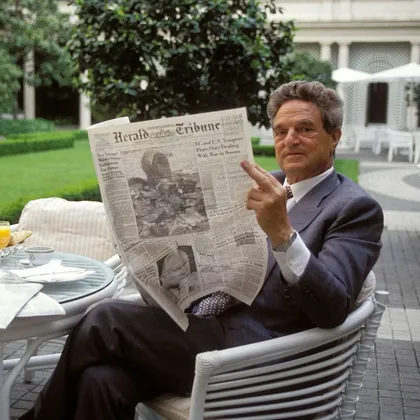
Let’s run Black Wednesday through the four-question framework.
The background. In 1990 the UK tied the pound to a band against other European currencies, with the German mark as the anchor (source). That meant the UK had to keep its interest rates roughly in line with Germany’s. But the two economies wanted opposite things. Germany, paying for reunification, kept rates high to fight inflation. The UK was sliding into recession and badly needed lower rates.
Thesis. The UK couldn’t keep punishing its own weak economy with high interest rates just to defend a currency level. Sooner or later, it would choose its economy over the peg.
Catalyst. As more traders sold pounds, the Bank of England had to spend its reserves buying them and raise rates to make holding pounds more attractive. Each defensive move made the economic pain, and the eventual surrender, more likely.
Trade. Sell pounds and buy German marks, in size. The fund’s trade was led by Stanley Druckenmiller, with Soros pushing to make it bigger (source).
Risk. If the UK held the peg, the pound would stay inside its band. That’s a small loss. If the peg broke, the pound would fall sharply. That’s a large gain. This is a textbook asymmetric bet.
On 16 September 1992 the peg broke, the pound fell, and the trade became the most famous in macro history. It’s also a warning to governments: markets tend to win when a policy fights economic reality.
Key takeaways
Section titled “Key takeaways”- Global macro means investing based on the big forces (growth, inflation, interest rates, currencies and government policy) rather than on individual companies.
- Macro investors mainly trade interest rates, currencies, commodities and stock indices, often with leverage.
- The best macro trades are asymmetric: small losses if wrong, large gains if right.
- Every trade starts with the same four questions: thesis, catalyst, trade, risk.